
Crypto Withdrawal Tax Scam: How Fake Tax and Clearance Fees Work
- Cryptocurrency
- Updated On: October 23, 2026
Table of Contents
A crypto withdrawal tax scam occurs when a fraudulent platform claims you must pay a tax, AML fee, or regulatory clearance charge before withdrawing your cryptocurrency. The demand may sound official, but it can be a tactic to extract more money from investors.
These scams often begin with a trading platform displaying profits. When you try to withdraw your funds, the platform demands a separate crypto withdrawal fee for tax clearance, compliance approval, or account verification. Even after payment, your funds may remain blocked and new charges may appear.
Scammers use terms such as “tax clearance certificate,” “AML verification,” and “regulatory approval” to make these demands seem legitimate. Understanding the difference between a genuine tax obligation and a fake crypto tax payment scam can help you recognize suspicious requests before sending more money.
This guide explains common crypto tax and compliance scams, how to identify fraudulent demands, and what steps to take when a platform refuses to release your funds.
What Is a Crypto Wallet Tax Scam?
A crypto wallet tax scam is a form of fraud in which fraudsters pretend that you need to pay a tax, regulatory fee, or compliance fee before you can access your cryptocurrency. It is a fake demand that is intended to appear official and urgent.
In most cases, the scam appears after a victim sees profits on a trading platform. When they attempt to withdraw, they receive a message saying a withdrawal tax, compliance fee, or regulatory clearance payment is required first. This is often called a crypto withdrawal tax scam or a wallet unlock tax scam.
Many victims ask:
Do I need to pay tax before withdrawing cryptocurrency?
A platform's demand for a separate crypto payment before releasing funds should be treated with caution. Actual tax obligations depend on your circumstances and local rules. Verify tax claims independently through the relevant tax authority or a qualified tax professional rather than sending cryptocurrency to a wallet provided by the platform.
Scammers may also use technical phrases like:
- “Blockchain verification fee”
- “AML compliance review”
- “Regulatory approval pending”
- “Tax clearance certificate required”
These terms are meant to create confusion. In reality, blockchain networks do not issue tax invoices, and compliance checks do not require sending crypto to a private wallet address.
If someone is asking you to transfer cryptocurrency to release your own funds, it is very likely a crypto wallet tax scam.
Who Is Most Targeted by Crypto Withdrawal Tax Scams?
A crypto withdrawal tax scam can target both new and experienced investors. Scammers often wait until someone tries to withdraw their funds before introducing a fake tax payment, AML verification charge, or regulatory clearance fee.
People who may be particularly vulnerable include:
- New crypto investors who are unfamiliar with normal withdrawal procedures and cryptocurrency fees.
- Users of unfamiliar trading platforms that display profits but provide little verifiable information about their operations.
- Investors who have already deposited large amounts and feel pressured to pay a crypto withdrawal tax demand to access their money.
- People using fake investment apps that introduce a crypto tax clearance scam when a withdrawal is requested.
- Investors facing repeated compliance demands who are told to pay additional fees for AML checks, regulatory approval, or account release.
Scammers often exploit the fear of losing an existing investment. They may make a fake crypto tax payment scam sound like the final step before releasing funds, even when each payment leads to another demand.
Being targeted does not mean you were careless. These schemes are designed to appear legitimate. Recognizing suspicious payment requests and verifying them independently can help prevent further losses.
How Do Crypto Withdrawal Tax Scams Work?
A crypto withdrawal tax scam often begins with a platform displaying profits, then turns into a series of payment demands when you try to withdraw your funds. Scammers may claim that a tax payment, AML check, or regulatory clearance fee must be completed before your cryptocurrency can be released.
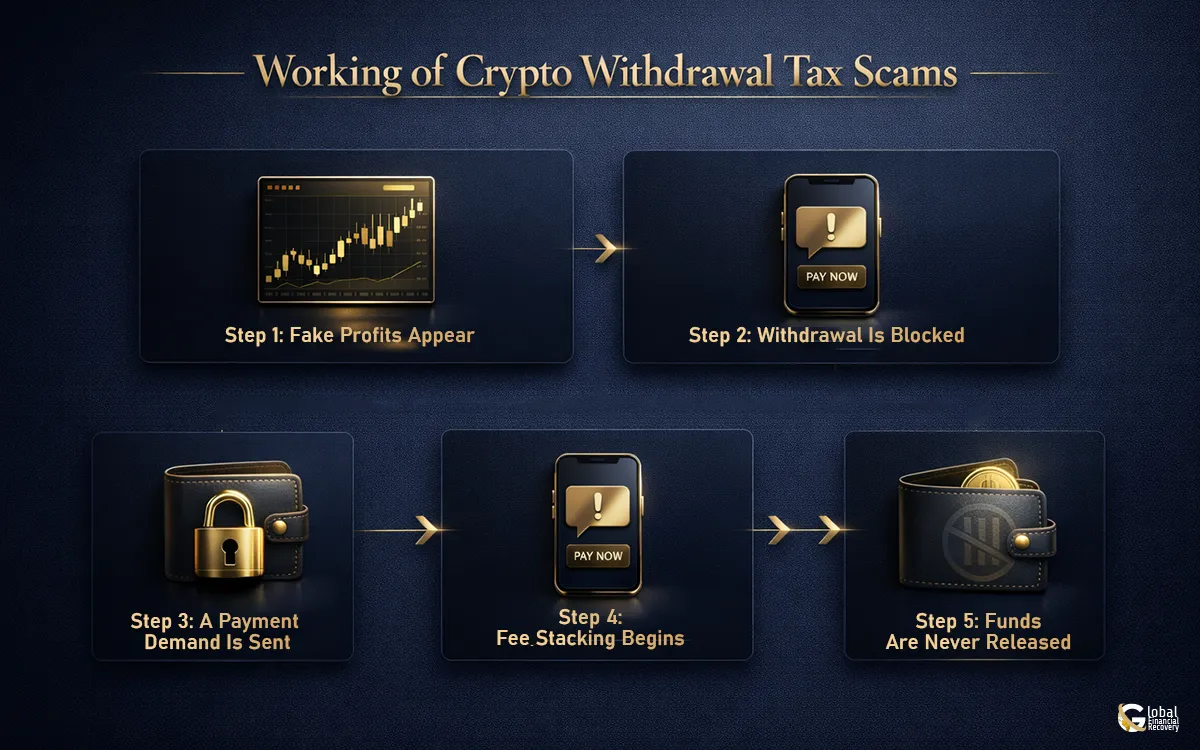
Here is how the process typically unfolds.
Step 1: Fake Profits Build Trust
Scammers may introduce investors to a trading platform through social media, messaging apps, investment groups, or online advertisements. The platform displays growing balances, apparent profits, and transaction histories to make the investment look genuine.
Some platforms even provide responsive customer support or allow small withdrawals to build confidence. However, a professional-looking dashboard does not prove that the displayed funds or profits are real.
Step 2: The Platform Blocks Your Withdrawal
The problem often begins when you request a withdrawal. Instead of processing it, the platform claims that an outstanding payment or approval is required.
You may see messages such as:
- “Withdrawal pending tax clearance.”
- “Crypto tax payment required before withdrawal.”
- “AML verification incomplete.”
- “Regulatory clearance fee must be paid before release.”
These messages can make a fake crypto tax payment scam appear legitimate. The platform may present the charge as a legal obligation, even when it cannot provide independently verifiable evidence to support the demand.
Step 3: A Separate Tax or Clearance Payment Is Demanded
The platform instructs you to send cryptocurrency to a specified wallet address before it will process your withdrawal.
The charge may be described as:
- A crypto withdrawal tax demand
- A crypto tax clearance fee
- An AML verification payment
- A crypto compliance fee
- A fake regulatory clearance fee
Scammers may provide invoices, certificates, or official-sounding explanations to make the payment seem necessary. They may also impose a short deadline to pressure you into acting quickly.
Before sending anything, verify the claimed tax or compliance requirement through independent, trusted sources. Do not assume that a payment is legitimate simply because the platform calls it mandatory.
Step 4: Additional Fees Keep Appearing
After the first payment, the platform may claim that another requirement remains incomplete. This is known as fee stacking, a tactic used to extract repeated payments without resolving the original problem.
You may receive messages such as:
- “Additional AML verification required.”
- “Compliance audit incomplete.”
- “Tax clearance certificate pending.”
- “Final processing fee required for fund release.”
At this stage, you may wonder, “Why is a crypto platform asking for tax before withdrawal?”
One possible explanation is that the platform is using a fraudulent withdrawal process to obtain more money. Each new charge creates another reason to delay the withdrawal. Paying one fee does not establish that the next demand is genuine or that your funds will be released.
Step 5: Your Funds Remain Inaccessible
Even after several payments, the platform may continue blocking withdrawals. It might stop responding, restrict your account, or demand one final release payment.
The balance displayed on the platform may be fabricated, or the platform may have received real cryptocurrency that it refuses to return. The actual circumstances need to be assessed using available account records and transaction evidence.
When cryptocurrency has been transferred on-chain, transaction records may help investigators examine where it moved. However, the displayed account balance alone does not prove that funds remain available, and blockchain tracing cannot guarantee recovery.
Keywarningsign: A platform repeatedly demands separate tax, AML, or regulatory payments before releasing your balance, especially when you can't independently verify those charges. Stop making additional payments until you've verified the claims.
Common Crypto Wallet Tax Scam Types
Most crypto wallet tax scams follow the same pattern: fake profits, blocked withdrawals, and a demand for payment. However, scammers use different explanations to make the fee sound legitimate.
The table below summarizes the main types of crypto wallet tax scams and how they differ.
|
Scam Type |
How It Works |
What They Say / Do |
|
Crypto Withdrawal Tax Scam |
Withdrawal is blocked until a “tax” is paid in crypto. After payment, more fees appear. |
“15% withdrawal tax required.” “Tax must be prepaid before release.” |
|
Blockchain Verification / Gas Fee Scam |
The platform claims that blockchain verification or gas confirmation is needed before release. |
“Network tax pending.” “Manual gas fee required.” “Blockchain confirmation needed.” |
|
The account suddenly shows frozen or restricted due to unpaid tax or review. |
“Unpaid withdrawal tax detected.” “Regulatory hold applied.” “Unlock fee required.” |
|
|
Compliance / KYC / Regulatory Fee Scam |
Withdrawal blocked for AML, compliance, or regulatory approval. |
“Compliance review pending.” “Regulatory clearance fee required.” “KYC tax payment needed.” |
|
The platform claims a clearance certificate must be issued before funds can be released. |
“Tax clearance certificate required.” “Processing fee before approval.” “Final release charge due.” |
Across these scam types, the pattern is often similar. The platform first displays apparent profits to build trust. When you request a withdrawal, it blocks access to your funds and demands a tax payment, AML verification charge, or regulatory clearance fee. After you pay, new charges may appear, while your withdrawal remains pending or is repeatedly denied.
A platform that demands separate, unverified cryptocurrency payments to release your balance is showing a serious warning sign of a crypto withdrawal tax scam. Verify the claims independently before sending any additional funds.
Red Flags of a Crypto Withdrawal Tax Scam
If a platform asks you to send cryptocurrency to unlock your own funds, that alone is a major warning sign. Legitimate crypto platforms do not operate this way.
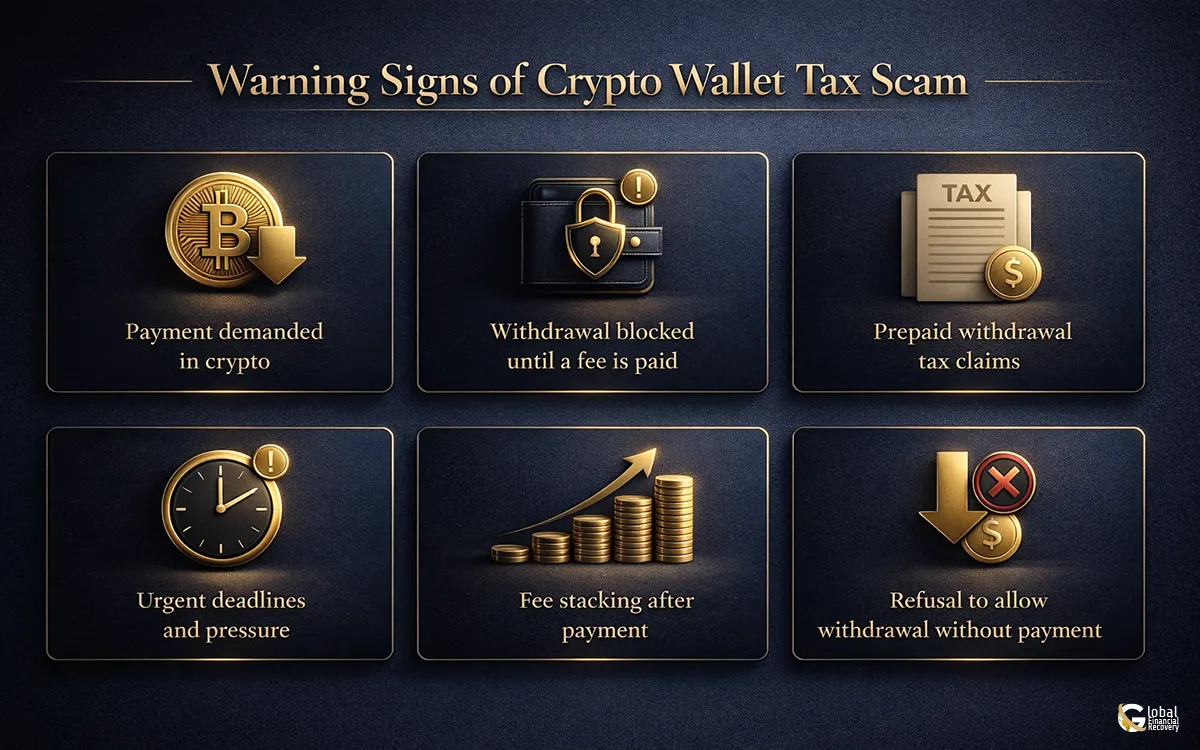
Common red flags of a crypto wallet tax scam include:
- Payment demanded in cryptocurrency.
You are asked to send crypto separately to clear a withdrawal tax, compliance fee, or regulatory charge. - Withdrawal is blocked until a fee is paid.
Everything appears normal until you try to withdraw; then a “tax” or “clearance” payment is suddenly required. - Prepaid withdrawal tax claims.
You are told you must pay tax before withdrawing crypto. Real exchanges deduct fees automatically. - Urgent deadlines and pressure.
Messages warn that your wallet will remain frozen or funds lost if you don’t pay within 24–48 hours. - Official-sounding technical language.
Terms like “blockchain verification fee,” “AML compliance hold,” or “regulatory clearance required” are used to sound legitimate. - Claims your wallet is frozen for unpaid tax.
Self-custody wallets cannot be frozen remotely. Any tax-based freeze demand is suspicious. - Fee stacking after payment.
After paying one fee, new charges appear (processing fee, verification fee, release fee). Legitimate fees do not multiply this way. - Refusal to allow withdrawal without payment.
If a platform will not release funds unless you send crypto first, it is likely a crypto withdrawal tax scam.
The key rule to remember is simple:
You never have to send cryptocurrency to unlock your own balance.
What to Do If You Already Paid a Crypto Withdrawal Tax Fee Scam

You paid the requested crypto tax or compliance fee, expecting your funds to be released. But the withdrawal is still blocked, or the platform is asking you to pay another charge. This can be a sign of a crypto withdrawal tax fee scam, where repeated payment demands are used to take more money without releasing your funds.
Paying another fee is unlikely to solve the problem. Instead, focus on these five steps to protect your evidence, report the transaction, and understand your options.
1. Stop Sending Money
Do not pay any more taxes, verification charges, or compliance fees to unlock your account. Scammers may claim that your previous payment was incomplete or that a new approval is required. These demands can continue even after you pay.
2. Save All Evidence
Keep screenshots of your account dashboard, payment instructions, wallet addresses, chat conversations, emails, and transaction IDs (TXIDs). Record the amounts paid and the dates of each transfer. This evidence can help establish how the scam happened and support further investigation.
3. Report the Transaction to Your Exchange
If you sent cryptocurrency through an exchange, contact its support team as soon as possible. Report the suspected fraud and share the transaction hash and receiving wallet address. The exchange may be able to flag suspicious activity, although this does not guarantee that your funds can be recovered.
4. Check Where Your Cryptocurrency Went
Use the relevant blockchain explorer to check whether your transaction was confirmed and review the available transaction details. Blockchain records may show the receiving address and subsequent transfers, although they do not automatically reveal the identity of the person controlling a wallet.
You can learn more about how blockchain analysis helps verify trading platforms and identify potential scams.
5. Consider Professional Investigation Support
Tracing funds after a crypto withdrawal tax fee scam can be complicated, particularly when cryptocurrency moves through multiple wallets or services. Professionals experienced in financial investigation and blockchain tracing can review your records, examine transaction patterns, and assess potential leads.
Be cautious of anyone promising guaranteed recovery or demanding additional fees to release your funds. A credible investigation should explain what the available evidence can establish and what limitations remain.
How to Avoid Crypto Withdrawal Tax Scams
A request to pay cryptocurrency before withdrawing your existing funds is a serious warning sign. Fake crypto tax and compliance fee scams often involve extra payments for tax clearance, verification, or regulatory approval. These demands can continue even after the first payment.
Follow these steps to protect your funds:
- Check withdrawal fees: Read the platform's official fee policy before depositing money. Be cautious of separate crypto payments demanded to unlock your balance.
- Research the platform: Check its company details, registration where applicable, and independent reviews. A professional-looking website or displayed profits do not prove that a platform is genuine.
- Watch for repeated charges: Requests for additional taxes, compliance fees, or regulatory clearance after an earlier payment can indicate a scam.
- Verify payment requests: Messages such as “withdrawal tax required” or “compliance fee pending” deserve careful checking. Contact the platform through independently verified channels before taking action.
- Never rush into another payment: Scammers often create urgency to stop people from questioning their demands. Pause, verify the request, and never send more cryptocurrency just to release blocked funds.
Already Paid a Suspicious Fee?
Save your transaction records, wallet addresses, payment instructions, and conversations with the platform. A professional investigation may help clarify where the funds moved and what options are worth exploring.
Global Financial Recovery's crypto tax fraud investigation service reviews available evidence and transaction activity to assess potential next steps. Be cautious of anyone promising guaranteed recovery or demanding additional payments to release your funds.
Staying Safe from Crypto Wallet Tax Scams
Crypto wallet tax scams are designed to feel official. They use words like “withdrawal tax,” “regulatory clearance,” and “compliance fee” to create urgency and fear. But the structure is always the same: profits appear, withdrawals are blocked, and payment is demanded before funds are released.
Real blockchain networks do not charge tax payments to unlock wallets. Legitimate exchanges do not require separate cryptocurrency transfers for compliance approval. If you are asked to send crypto to access your own balance, something is wrong.
Understanding how these scams operate is the first layer of protection. Recognizing the red flags is the second step. Acting quickly and refusing to send additional funds is the most important step.
If you believe you’ve been targeted by a crypto withdrawal tax scam, you can contact Global Financial Recovery for guidance on potential fund tracing and recovery options.
The more informed you are, the harder it becomes for scammers to succeed.
FAQs (Frequently Asked Questions)
No. Legitimate crypto exchanges deduct trading or network fees automatically from your balance. You do not need to send a separate cryptocurrency payment to unlock your funds. If a platform asks you to prepay a withdrawal tax, it is likely a crypto withdrawal tax scam.
No. Blockchain networks do not issue tax invoices or require manual “verification payments.” Gas fees are automatically included in transactions. If you are asked to send crypto to complete a blockchain verification, it is almost certainly a scam.
Self-custody wallets cannot be frozen remotely for unpaid taxes. Scam platforms may display a fake “account frozen” message to pressure victims into paying a compliance or unlock fee. Real tax matters are not handled through wallet payment demands.
Scammers often use legal terms like AML review, compliance clearance, or regulatory approval to sound official. Legitimate exchanges complete identity verification before trading and do not require crypto payments to pass compliance checks. If payment is requested in cryptocurrency, that is a red flag.
Stop sending additional funds immediately. Save all transaction details, wallet addresses, and communication records. Avoid anyone promising guaranteed recovery. If needed, seek guidance from a legitimate cryptocurrency recovery service that focuses on blockchain tracing and evidence review.
Book A Free Consultation
Recent Posts



From case evaluation to financial investigation, Global Financial Recovery provides transparent guidance to help you understand your case and explore your options.